
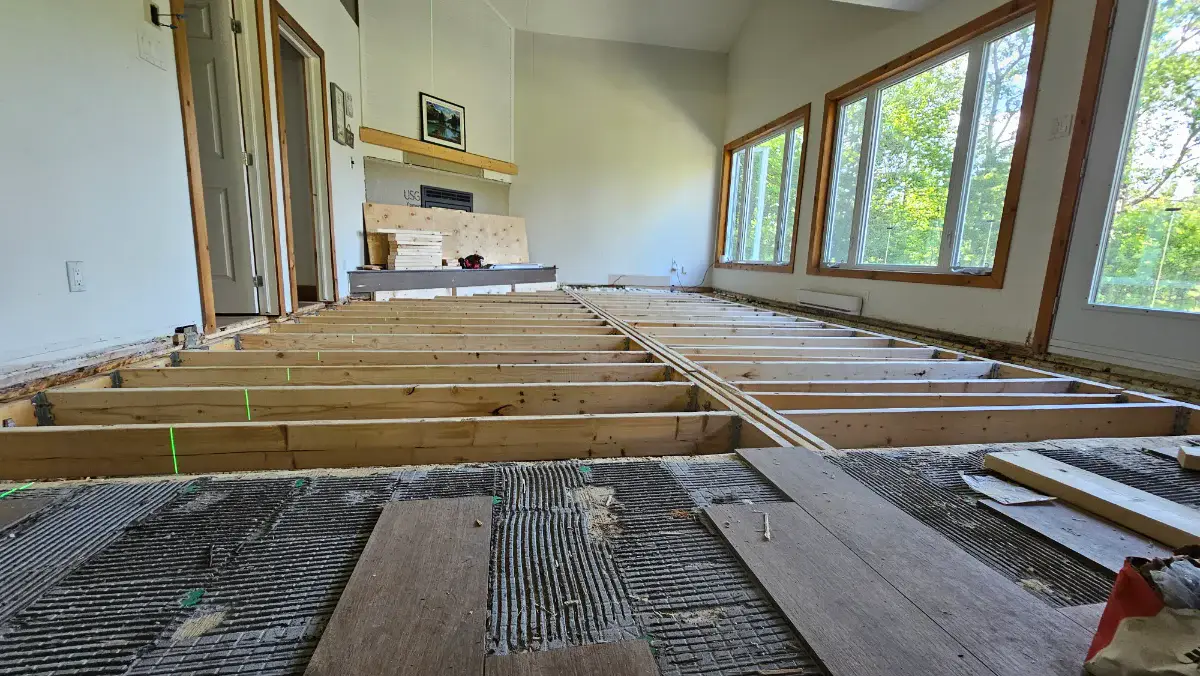
Almost every house has a floor that creaks somewhere. Wood moves with the seasons, humidity changes, and a slight creak is not necessarily a problem. But a floor that sags, that moves underfoot or that is no longer level is sending a different message. Here is how to tell the difference, and what we do when the cause is in the structure.
Signs that deserve an assessment
Some symptoms are mostly cosmetic. Others show that the structure under the floor is no longer doing its job. These deserve a closer look:
- a floor that flexes or bounces when you walk on it;
- a visible slope, or a marble that always rolls the same way;
- doors that stick or swing shut on their own;
- cracks that appear or grow in the drywall, near door frames;
- cracking grout or loose tiles;
- a creak that gets worse over time.
A single sign does not mean the house is in danger. But when several show up together, or keep changing, it is time to have the structure assessed.
What hides under the flooring
A floor has several layers: the visible flooring (wood, laminate, tile), the subfloor, then the joists that carry everything and rest on beams, bearing walls or the foundation. A problem can come from any of these layers.
Causes we run into include joists too weak for their span, cut during old plumbing or electrical work, or weakened by moisture; a subfloor that is too thin or damaged; a support that has shifted; or an old floor covered with new layers without fixing the base. In an extended house, the floor often deforms where the old and new parts meet.
Why not just lay a new floor
It is tempting to cover up the problem: new flooring, some self-leveller, and the floor looks new. But if the cause is in the structure, the problem comes back. A floating floor laid on a base that moves will creak and separate. Tile on a subfloor that flexes will crack. That is why we prefer to open it up and look, removing the flooring and, if needed, the subfloor to see the real condition of the joists.
How we fix it at the source
Once the cause is found, the solutions depend on what we see: reinforcing or sistering joists, adding supports, bringing the structure back to level, installing a new, stiffer subfloor. These are the steps you no longer see once the work is done, and the ones that matter most.
Only then comes the flooring. On a solid, level base, large-format tile installed with a levelling system and a laser level gives a straight floor that no longer moves. Our home page shows one of our jobs: a floating floor that moved underfoot and was no longer level. We opened it, corrected the structure and rebuilt it all the way to the tile.
What changes the scope of the work
Without seeing the floor, there is no way to say what it will need. The scope depends on the area affected, the condition of the joists, access from below (an unfinished basement helps), the type of flooring to reinstall, and what we find once it is open. That is why we start with an assessment, then a clear quote suited to your situation.
The right reflex
A floor that worries you is a good reason to call before renovating. Vanguard Construction Solution assesses the structure, explains what we see and proposes the possible solutions, in Sainte-Agathe-des-Monts and across the Laurentians. The quote is free.
Have a project in mind? See our service structural correction or request a free quote.
Request a quote